KherveDB
AvailableThe NIST XPS binding-energy database, preserved and searchable.
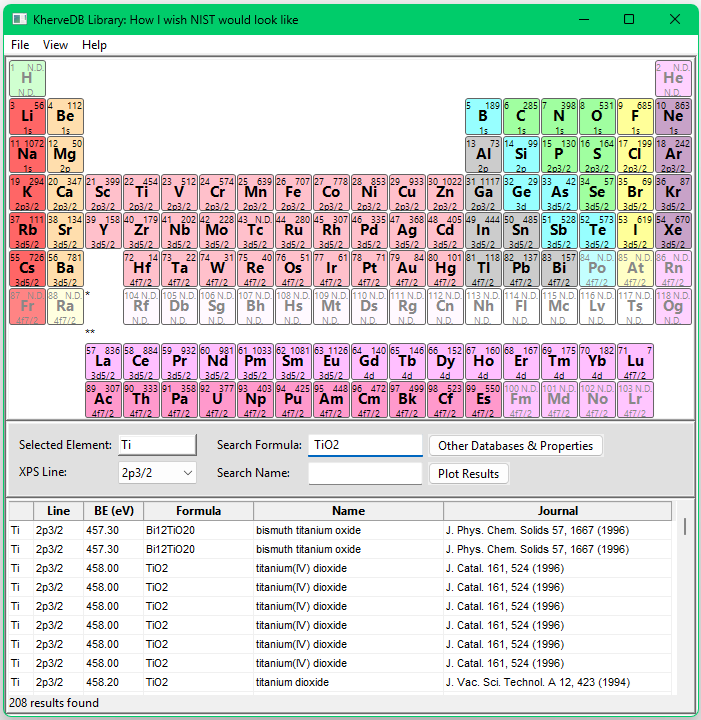
The complete NIST X-ray Photoelectron Spectroscopy binding-energy database (archived in 2019) behind a colour-coded periodic table. Click an element to list its entries, right-click it for its electronic structure, XPS peak positions, spin-orbit splitting and common overlaps, and open a tabbed browser on XPS Fitting, Harwell XPS Guru, Thermo Knowledge and Google Scholar that follows the element you select. Version 5 is rewritten in React and Tauri: a 4 MB installer that starts instantly, and also runs in the browser.
Attributes
- Interactive, colour-coded periodic table — click an element to see its NIST entries
- The complete NIST XPS binding-energy database, archived from 2019 (~56,000 entries)
- Search by element, XPS line, chemical formula, or compound name; click an entry for every detail
- Right-click an element: electronic configuration, XPS peak positions, spin-orbit splitting and overlaps
- Tabbed reference browser (XPS Fitting, Harwell XPS Guru, Thermo Knowledge, Google Scholar) that follows the selected element
- Histogram plot of the binding-energy distribution
- 4 MB installer on Windows, 10 MB DMG on macOS (Apple Silicon and Intel), light and dark mode, signed auto-update — and a web version that needs no install
Built with
A modern stack of well-known scientific Python libraries.
Documentation
macOS
Download the disk image for your Mac — Apple Silicon (M1 and later) or Intel — open it and drag KherveDB to Applications. The app is not notarised, so the first launch needs a right-click on it and Open (on recent macOS: System Settings ▸ Privacy & Security ▸ Open Anyway). After that it updates itself like the Windows version. It uses the WebView built into macOS, so the download is about 10 MB.
Web version
KherveDB 5 also runs in the browser with nothing to install: https://gkerherve.github.io/KherveDB-React/ — the same database and periodic table. Reference sites open in new browser tabs there, since they cannot be embedded in another website; the desktop app shows them in its own tabbed window.
Classic version
KherveDB 4.1, the original wxPython application, remains available from the version history below. Its built-in updater offers KherveDB 5.
Getting started
Launch KherveDB and you land on an interactive periodic table. Click an element to pull up its XPS binding energies and core levels; elements with data are highlighted.
Searching the database
Search the full NIST set by element, XPS line, chemical formula, or compound name. Results appear in a sortable table with binding energies and core levels you can order and inspect.
About the data
KherveDB preserves the NIST X-ray Photoelectron Spectroscopy binding-energy database as archived in 2019, keeping this reference resource available to the community.
Versions
Disk image for Apple Silicon (arm64) and Intel (x86_64).
The new KherveDB, rewritten in React + Tauri: a 4 MB installer instead of ~200 MB, also available as a web app. Tabbed Other Databases & Properties window that follows the selected element, right-click XPS information (electronic structure, peak positions, overlaps), entry details, histogram plot, welcome window and signed auto-update.
Classic wxPython version: fixes the "failed to load NIST_BE" error of the packaged app, Edge WebView2 browsers with cookie banners declined, right-click XPS information, hover help, starting image, welcome window and auto-update.
NIST XPS binding-energy database viewer.
Part of the Kherve Tools family
Applications made by a scientist, for scientists.