AutoID survey identification
The AutoID system is a pattern-recognition tool for rapid analysis of survey and wide-scan XPS spectra — combining prominence-based peak detection with reference databases to give automated, ranked element assignments.
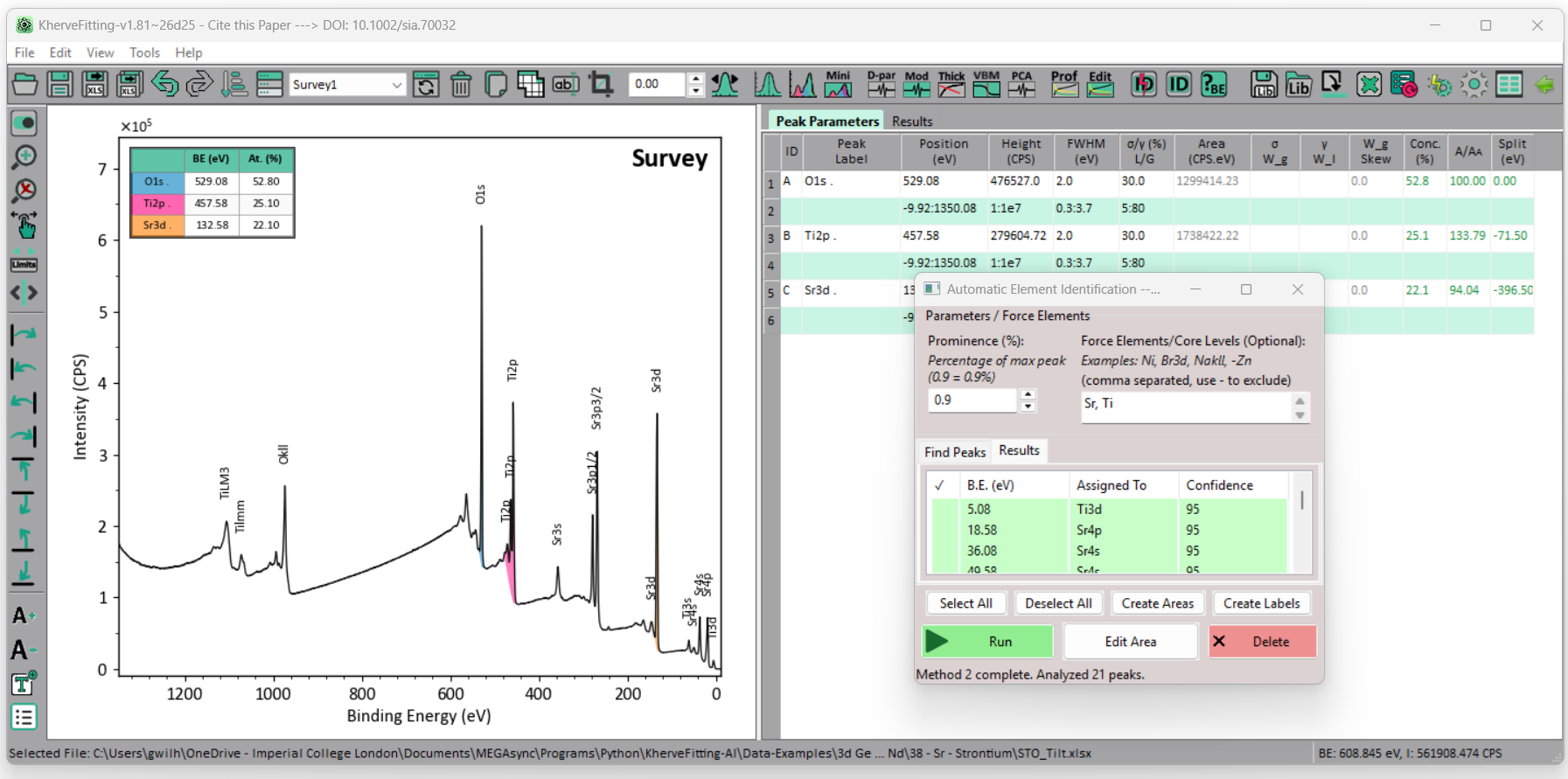
Peak detection
Detection uses the SciPy peak-finder with three core controls:
Prominence threshold — fraction of maximum intensity:
P_threshold = f_prom × I_max
f_prom is typically 0.5–2.0 % for survey spectra.
Width constraints — W_min ≤ FWHM ≤ W_max (typically 0.6–20 eV) to filter spurious
detections.
Distance — minimum separation ΔE ≥ D_min (typically 5 eV) to avoid over-detecting
within multiplets.
Peak matching
Detected peaks are matched to reference entries within an energy tolerance
|E_detected − E_reference| ≤ T_tolerance (typically 0.5–2.0 eV) to absorb:
- Energy calibration uncertainties
- Chemical shift variations
- Surface charging
- Instrumental drift
Auger recognition
Auger peaks are converted from kinetic energy to binding energy:
E_B(Auger) = hν − E_K(Auger)
KLL, LMM, MNN, and similar transitions are matched through pattern recognition that accounts for nomenclature variations across databases.
Forced element identification
Override automatic detection by specifying:
- Element symbols —
Ni,Br,Na - Core-level specs —
Br3d,C1s,O1s - Auger transitions —
NaKLL,CKLL,MgKLL
Useful when noise or overlap defeats automatic detection.
Quality assessment
Each identification is colour-coded and ranked by:
- Peak prominence vs noise
- Binding-energy match quality
- Multiplet intensity ratios
Always verify before publication — AutoID is a fast first pass, not a substitute for careful chemistry.