Peak models
KherveFitting provides several peak line shapes; Voigt (Area, L/G, σ) is recommended for its physical meaningfulness. LA (Area, σ/γ, γ) is familiar to CasaXPS users.
SGL (Sum of Gaussian / Lorentzian)
The default model — simple and useful for newcomers. Shape parameter L/G can be fitted or fixed.
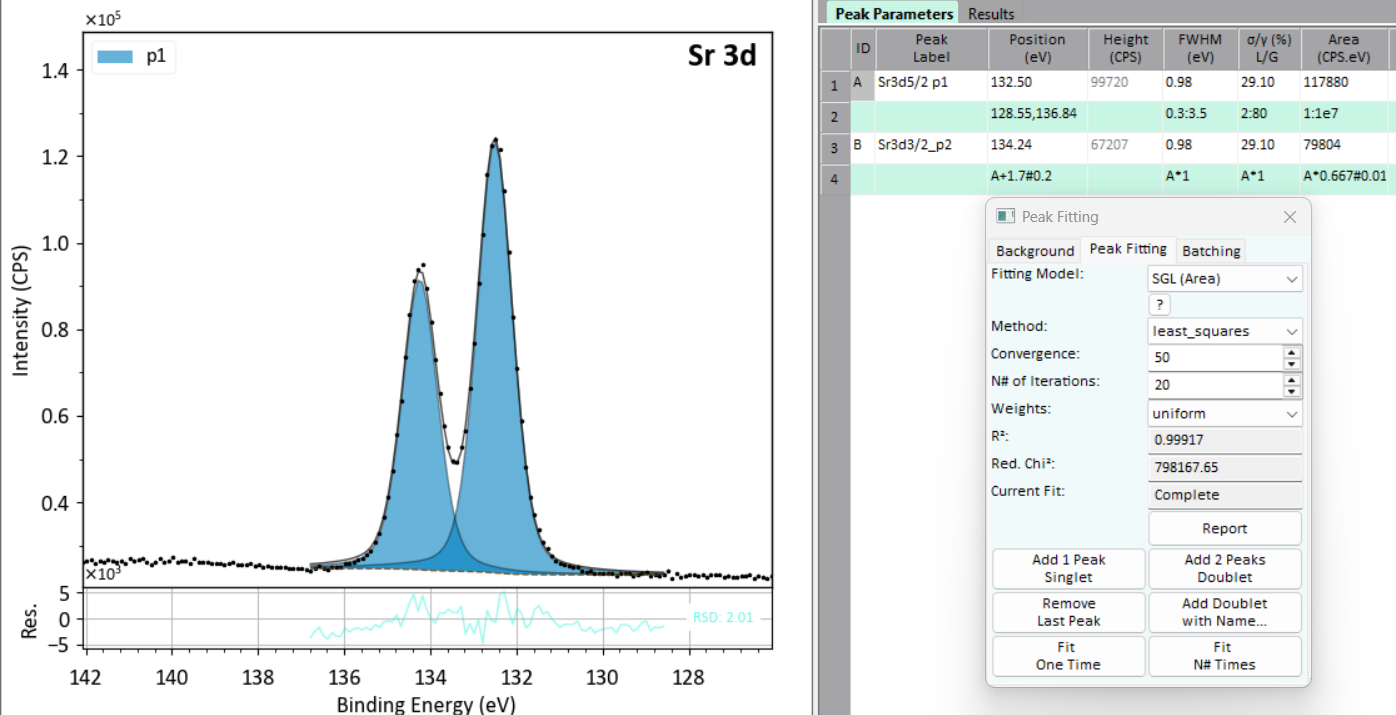
Tip: L/G changes with FWHM. Sharper peaks tend Lorentzian; broader peaks tend Gaussian. Avoid fixing L/G at 30 % across all peaks.
Voigt (Area, L/G, σ) — recommended
The convolution of a Gaussian and a Lorentzian. In KherveFitting you constrain the
Gaussian width and the L/G ratio; the Lorentzian width is computed. The grid shows
indicative W_g and W_l columns (grey, read-only) alongside fittable parameters (black).
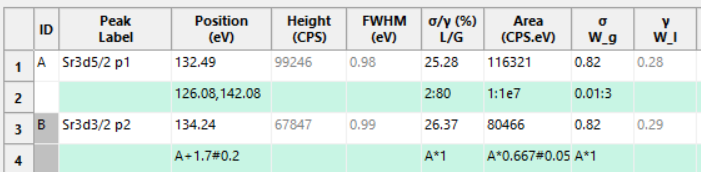
Rules of thumb for L/G:
- FWHM 1.0–1.5 eV → L/G ≈ 20 %
- FWHM > 1.5 eV → L/G ≈ 10–20 %
- FWHM < 1.0 eV → L/G rises sharply (50–60 %)
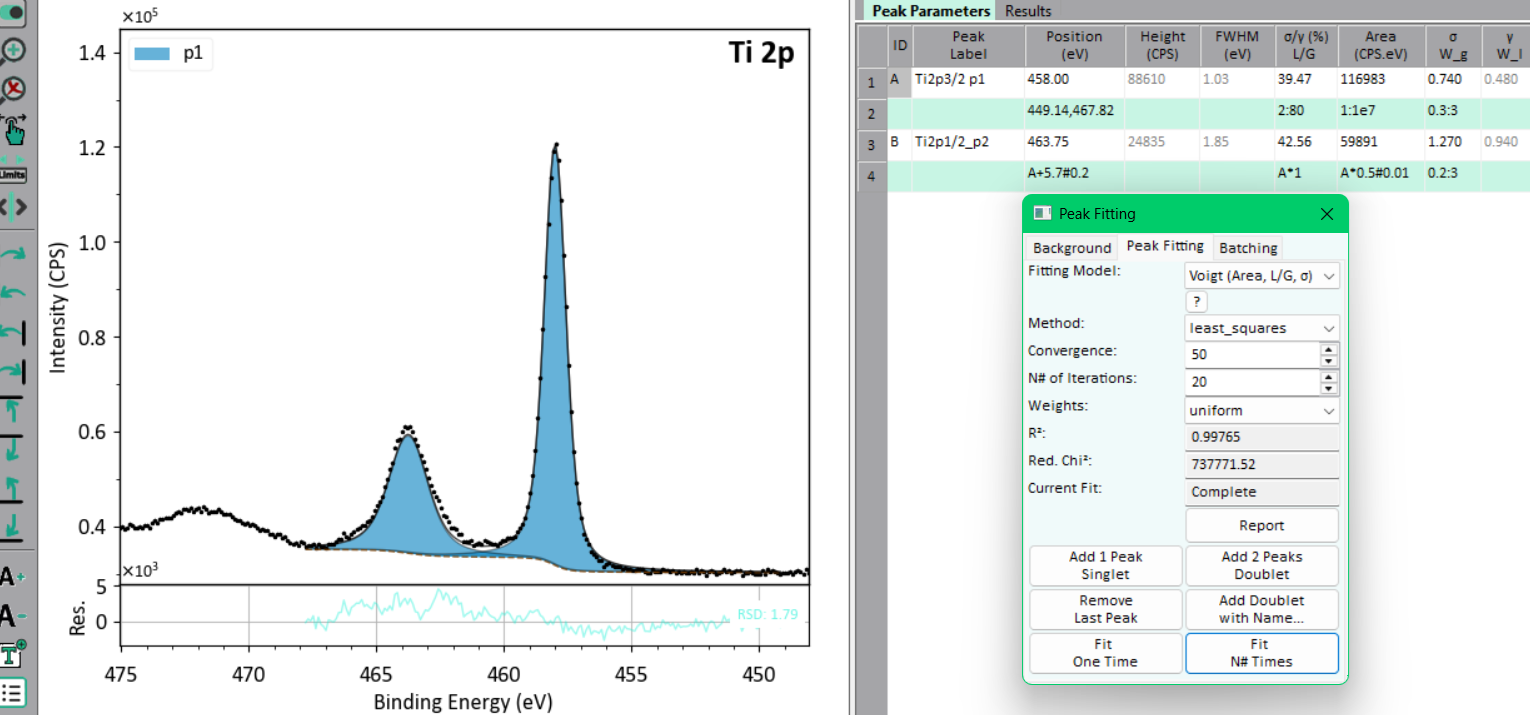
For Ti2p / V2p doublets, KherveFitting does not lock B's FWHM to A — Ti2p₁/₂ is broader than Ti2p₃/₂ for oxides due to the Köster-Kronig effect.
LA (Area, σ/γ, γ)
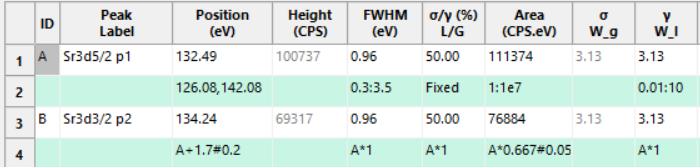
A pure Lorentzian powered on the right by γ and on the left by σ — the bigger the power, the more Gaussian. σ/γ controls asymmetry:
- σ/γ = 50 % (σ = γ) → fully symmetric peak (default)
- σ/γ < 50 % → asymmetric (good for metallic Pt 4f, conduction-band shoulders, …)
The model has no direct physical interpretation but is widely used in legacy CasaXPS
projects. Try it on the bundled Pt4f example.
Doniach-Sunjic
For asymmetric metallic core levels. Available via the lmfitxps integration.
Constraining doublets
When you press Add 2 Peaks, peak B is linked to peak A:
- Position —
A + ΔE # tol(e.g.A + 1.7 # 0.2) - FWHM —
A × 1(locked) or free (Ti2p / V2p) - Area —
A × ratio # tol(e.g.× 0.667 # 0.05for d-shell 4:6)
Constraints can be edited cell-by-cell in the peak fitting grid.