Background models
KherveFitting offers the standard XPS background subtraction methods, plus a Multi-Regions Smart mode that adapts the choice per region.
Linear
A two-point linear interpolation between the high-BE and low-BE endpoints:
B_L(E) = I_high · (E_low − E) / (E_low − E_high)
        + I_low  · (E − E_high) / (E_low − E_high)
Best for narrow, well-isolated peaks where the inelastic background is small.
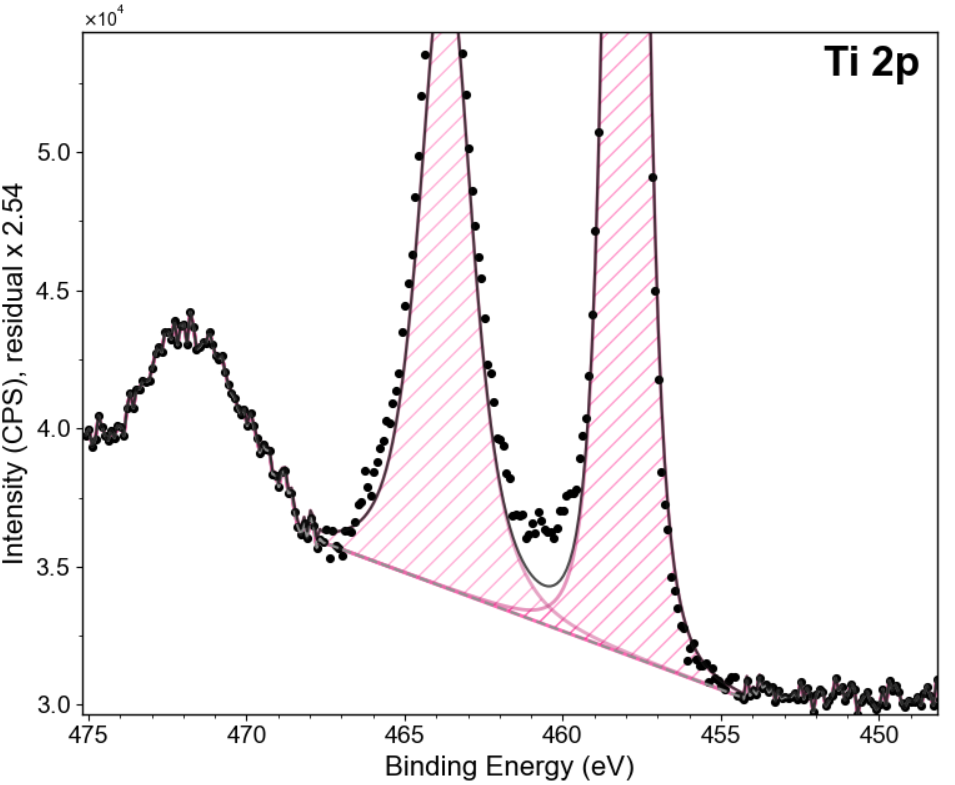
Shirley
The default for most C 1s, O 1s, and N 1s core levels. Good for moderate inelastic backgrounds and the de-facto standard for chemical-state fitting.
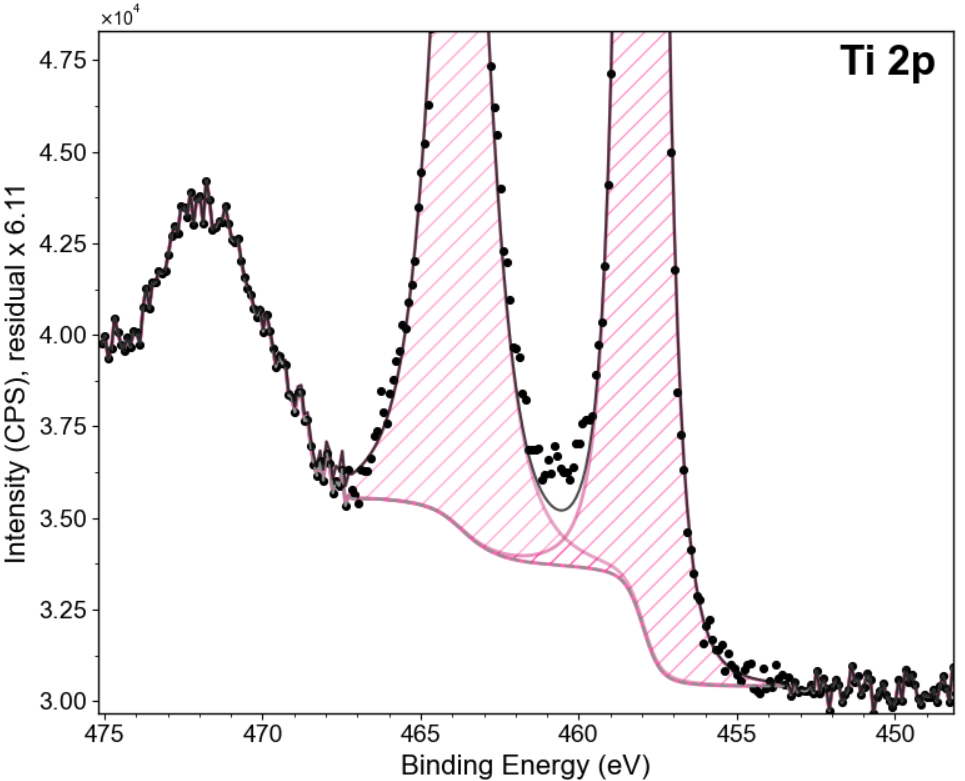
Tougaard (single & double)
Physically motivated for large inelastic backgrounds, wide windows, and depth-sensitive analysis. KherveFitting provides both single and double Tougaard variants.
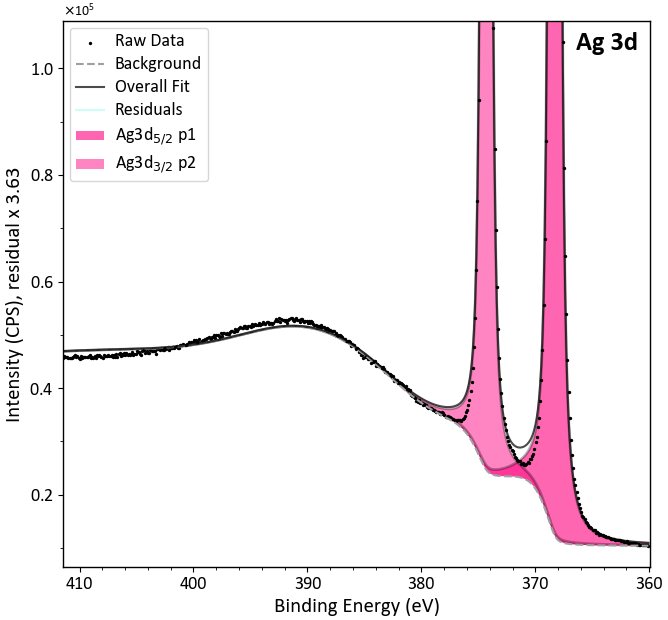
Multi-Regions Smart (default)
Splits the selected window into regions and applies an appropriate background per region — the right choice in most cases.
Advanced fitting with a multi-region Shirley (v1.93)
The Fitting Adv. tab of the Fitting window fits the peaks and the multi-region Shirley background at the same time. The offset of each region is tuned automatically during the fit, so complex spectra with overlapping peaks get a sensible background without hand adjustment.
- A lock keeps the background continuous where two regions join.
- Regions can still be dragged by hand on the plot, as in the Background tab.
- Fits are judged on residual flatness as well as chi-squared (Durbin-Watson, waviness).
- Use the Monte Carlo toolbar button afterwards for the uncertainty of each peak position.
Practical tips
| When… | Use |
|---|---|
| Most chemical-state fits (C 1s, O 1s, N 1s) | Shirley |
| Wide survey-style windows, strong inelastic tails | Tougaard |
| Narrow, isolated peaks | Linear |
| Mixed regions, fast workflow | Multi-Regions Smart |
Place vertical region lines in flat regions ~1–2 eV away from peaks for the most stable backgrounds. To fine-tune, hold Shift and drag a background endpoint.