KherveDB
KherveDB is the element and binding-energy database that ships with KherveFitting. It bundles a full periodic table view, NIST and Wagner-style binding-energy references, Auger lines, and the sensitivity factors used for atomic-percent quantification.
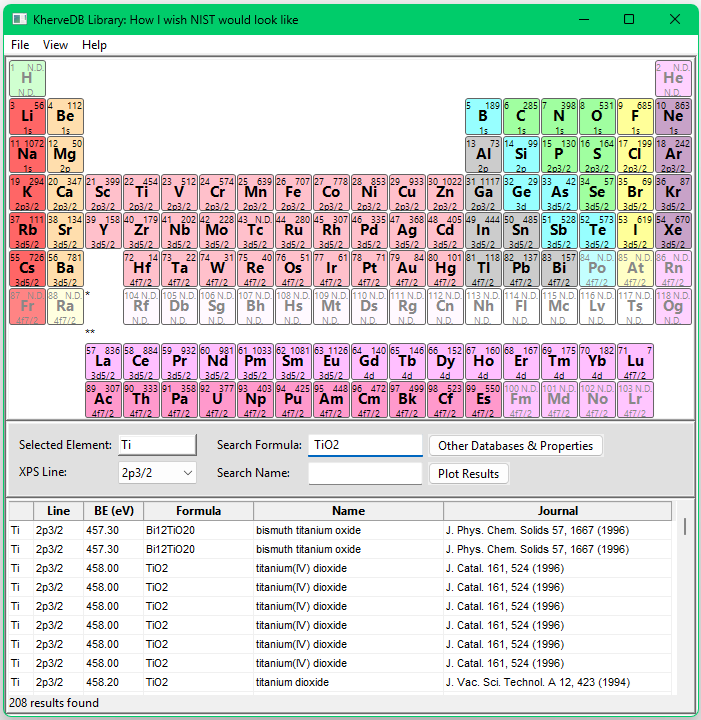
Built into the app — open it from the Help menu, or via the toolbar shortcut. Sometimes described in the title bar as "how I wish NIST would look like."
What's inside
- Periodic table integration — click any element to see its photoelectron and Auger lines, with binding energies sourced from XPS / NIST databases.
- Binding energy references for all elements from H to U, with chemical-state notes where commonly available.
- Auger peak database for KLL, LMM, MNN families — used by AutoID for survey identification.
- Sensitivity factors (multiple libraries: Scofield, Wagner, NIST, instrument-specific) applied automatically when exporting to the Results grid.
- LibraryID — automated element identification on survey scans, matching detected peaks to the database within a user-set tolerance window.
Typical workflow
- Run AutoID on your survey scan — KherveDB matches detected peak prominences against the reference table.
- Confirm or relabel each identification from the periodic-table view.
- Switch to a core-level scan; load a saved peak table or build one manually.
- On export to the Results grid, the configured RSF library is applied automatically.
Related
- AutoID surveys — the survey identifier that uses KherveDB internally.
- BE correction — align spectra to the reference values KherveDB exposes (C 1s 284.8 eV, Au 4f7/2 84.0 eV, Ag 3d5/2 368.3 eV, Cu 2p3/2 932.7 eV).